
Skip Counting by 2s & 10s | Learning Numbers and Basic Shapes
In this lesson, Toby guides learners through a fun and interactive counting adventure, starting with counting apples from one to five, then building a house using various shapes like squares, triangles, and circles. The lesson continues with counting cars parked in garages by twos and finally counting sheep by tens to help Toby fall asleep, reinforcing counting skills in a playful and engaging manner.
Logic Games for Kids | Matching Objects with Common Trait | Cartoon for Kids
In today’s lesson, young explorers learned how to group objects based on shared characteristics such as size, color, and patterns. Through engaging examples with animals like monkeys and elephants, children practiced identifying similarities and differences, reinforcing the concept that items can belong together even if they are different in other ways. The lesson encouraged curiosity and exploration, inviting children to continue discovering the world around them.
Best Classifying , Sorting and Matching Videos for Toddlers | Learning and Matching Colors For Kids
In this engaging lesson, children embark on an ocean adventure with Leo and his friends, learning about camouflage and hiding from a shark. They also assist Echor the Wizard in organizing items after a storm, help Lucas and Emmy sort beach toys by color, and participate in various activities like restoring colors to a gray town, organizing a bathroom, selecting birthday cakes, building nests, and matching outfits. Each segment emphasizes problem-solving, color recognition, and categorization, making learning interactive and fun.
The Secret to Chess Success: The Truth About Check!
In this lesson, Coach Rob introduces the concept of “check” in chess, explaining that it occurs when the king is threatened by an opponent’s piece. He outlines how different pieces can put the king in check and emphasizes the importance of keeping the king safe by moving it, blocking the attack, or capturing the threatening piece. The lesson concludes with a reminder to always be vigilant for potential checks during gameplay.
Word problems for 2nd Grade | Halloween Worksheets
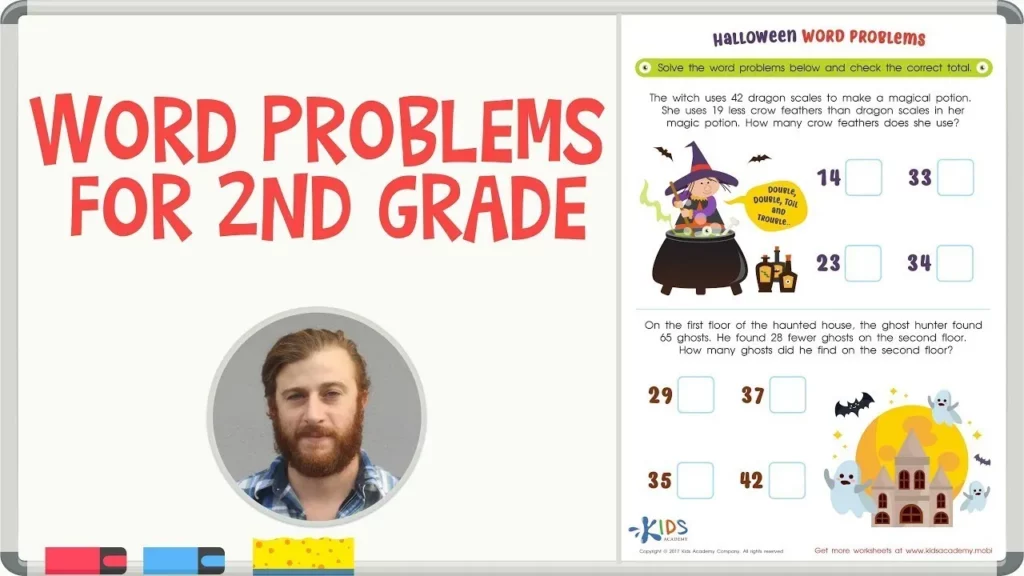
In this lesson, students embark on a “Spooky Math Adventure” where they tackle Halloween-themed word problems involving subtraction. They learn to identify key phrases like “fewer” and “less,” which indicate the need for subtraction, and practice solving problems by extracting important information and performing regrouping in subtraction. By the end of the lesson, students gain confidence in handling word problems and enjoy the fun, thematic approach to math.
Chess for Kids | Power and Value of Pieces
In this chess lesson, students learn about the value of each chess piece, which helps them make strategic decisions during the game. The king is the most important piece, while the queen is the strongest, valued at nine points, followed by the rook at five points, and both the knight and bishop at three points each, with the pawn valued at one point. Understanding these values is crucial for making smart trades and ultimately winning the game.
Learn Number Four 4 | Preschool & Kindergarten | Learn Like Nastya
In this lesson, students learn about the number four through engaging examples involving four cats, four raindrops, and four umbrellas. The lesson emphasizes counting and encourages students to practice counting with everyday objects, reinforcing the concept of the number four in a fun and interactive way.
How to Achieve Checkmate in 2 Moves | Chess Lessons for Kids
In today’s lesson at Kids Academy, we explored the chess tactic known as “checkmate in two,” where a player can secure victory in just two moves regardless of the opponent’s responses. Through various examples involving different pieces, we learned how to strategically plan moves and utilize “forcing moves” to achieve checkmate. With practice and visualization, players can enhance their skills and become proficient in this exciting chess strategy.
Comparing & Measuring Lengths | Math for 2nd Grade
In today’s lesson with Teacher Mike, students learned how to compare the lengths of different objects using centimeters by measuring and subtracting the lengths. Through examples involving nails, a paperclip, an eraser, a marker, and a pen, they practiced finding out how much longer one object is than another. The key steps emphasized were measuring both objects, subtracting the shorter length from the longer length, and recording the difference.
How Rook Moves and Captures | Chess Lessons
In this lesson, students are introduced to the rook, a powerful chess piece that moves in straight lines either vertically or horizontally across the board. They learn how to count the squares the rook can move, how to capture other pieces, and are challenged to practice moving the rook in different scenarios. The lesson emphasizes the rook’s movement capabilities and sets the stage for future lessons on other chess pieces.