
Finding the vertex of a parabola example | Quadratic equations | Algebra I
In this lesson, we explored how to find the vertex of a quadratic function, which is represented by the equation \( y = ax^2 + bx + c \). We learned two methods for determining the vertex: using the vertex formula \( x = -\frac{b}{2a} \) and completing the square, both of which revealed that the vertex of the example function \( y = 5x^2 – 20x + 15 \) is located at the point \( (2, -5) \). Understanding these techniques is essential for analyzing the characteristics of parabolas in algebra.
Finding mean, median, and mode | Descriptive statistics | Probability and Statistics
This lesson introduces the concept of central tendency in statistics, focusing on the mean, median, and mode as methods to determine the typical value of a dataset. The mean is calculated by averaging all numbers, the median is the middle value when arranged in order, and the mode is the most frequently occurring number. Understanding these measures is essential for analyzing data effectively and making informed decisions.
Origins of algebra | Introduction to algebra | Algebra I
The lesson explores the historical origins of algebra, tracing its development from ancient Babylonian mathematicians to the groundbreaking work of Al-Khwarizmi in the 9th century, who introduced the term “algebra” and emphasized the importance of balancing equations. It highlights the contributions of various cultures and mathematicians, including Diophantus and Brahmagupta, showcasing how algebra evolved through collaboration and knowledge sharing. Ultimately, the lesson underscores algebra’s significance in modern mathematics and its role in scientific and technological advancements.
Constructing a perpendicular bisector using a compass and straightedge | Geometry
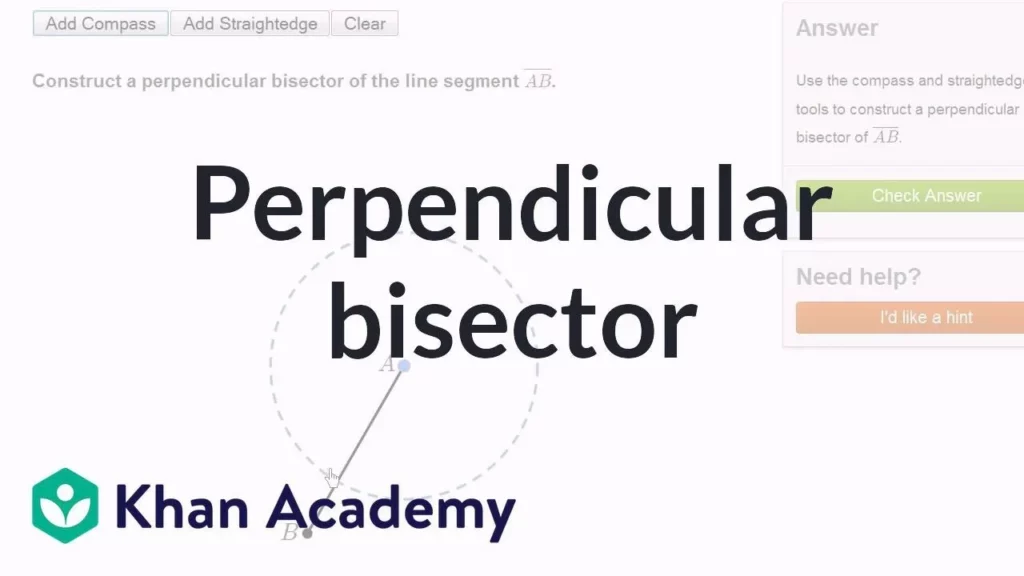
In this lesson, we learned how to construct a perpendicular bisector for a line segment, specifically segment AB, using a compass and straightedge. The process involves drawing two circles centered at the endpoints of the segment, identifying their intersection points, and connecting these points to create a line that intersects segment AB at a right angle, effectively dividing it into two equal parts. This technique is fundamental in geometry and can be applied to any line segment.
Critical points introduction | AP Calculus AB
This lesson focuses on understanding global and local maxima and minima in mathematical functions, emphasizing the role of derivatives in identifying these extrema. Through graphical analysis, we identified a global maximum and local extrema, while noting the absence of a global minimum. The lesson concludes by highlighting the significance of critical points, where the derivative is zero or undefined, in determining the nature of these extrema.
Adding vectors | Vectors and spaces | Linear Algebra
This lesson focuses on understanding vector addition in two-dimensional space, demonstrating how to add two vectors, Vector A and Vector B, by combining their respective components. It emphasizes the visual representation of vectors on a graph and introduces the commutative property, which states that the order of addition does not affect the result. Ultimately, the lesson illustrates that the sum of two vectors results in another vector, reinforcing the concept through both calculation and visualization.
History of the Republican Party | American civics | US government and civics
The lesson provides a historical overview of the Republican Party, tracing its origins from its founding in 1854 amid tensions over slavery to its evolution through key events in American history. It highlights significant moments, such as the party’s role in the Civil War, its post-war dominance in civil rights, the shift towards business interests during the Gilded Age, and the impact of the Great Depression on its political power. The lesson concludes by emphasizing the ongoing evolution of the Republican Party in response to changing political and demographic landscapes.
Combining like terms introduction | Introduction to algebra | Algebra I
This lesson provides a straightforward introduction to adding like terms in algebra, using engaging examples such as Chuck Norrises and plums to illustrate the concept. It emphasizes the importance of identifying and combining coefficients of like terms while keeping different types of terms separate, ultimately reinforcing the fundamental skills needed to simplify algebraic expressions effectively.
Example: Trig to solve the sides and angles of a right triangle | Trigonometry
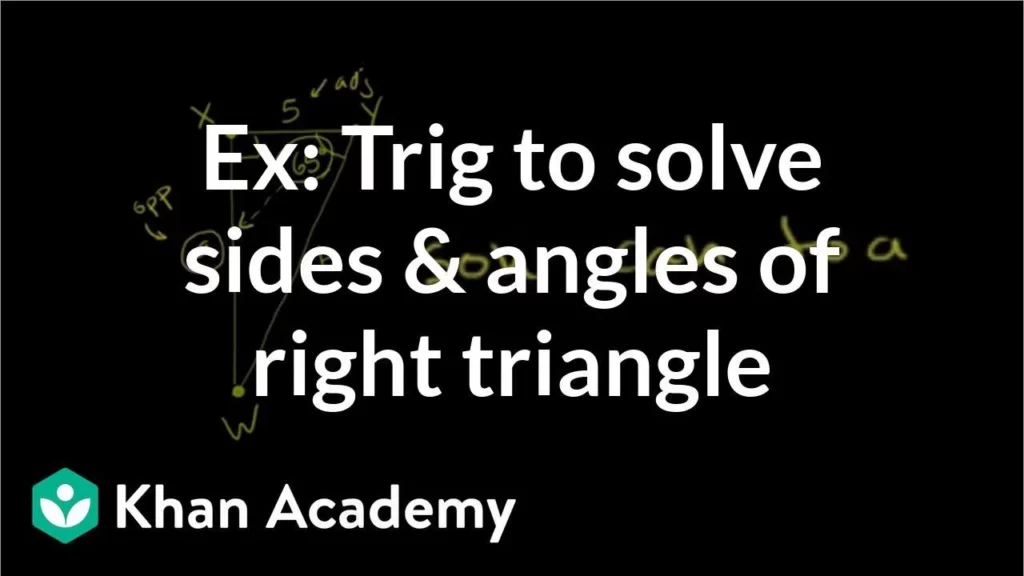
This lesson provides a step-by-step guide on solving a right triangle by determining the lengths of its sides and the measures of its angles using trigonometric functions. By applying the tangent function to find side \( a \) and the cosine function for side \( b \), we calculated their lengths to be approximately 10.7 and 11.8, respectively, while also determining the measure of the remaining angle \( W \) to be 25 degrees. The lesson emphasizes the use of trigonometric relationships and triangle properties to find unknown values in right triangles.
Introduction to transformations | Transformations | Geometry
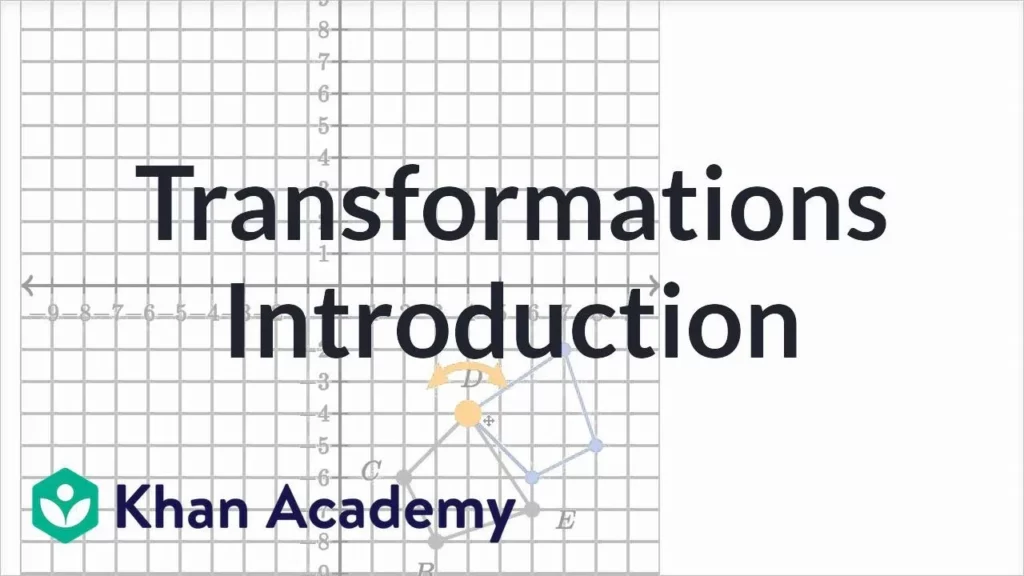
In this lesson, we explored the concept of transformations in mathematics, which involve changing shapes or figures through methods such as translation, rotation, and reflection. These transformations can be categorized into rigid transformations, which maintain the shape’s size and angles, and non-rigid transformations, which alter the shape or size. Understanding these concepts is essential not only in mathematics but also in practical applications like computer graphics and advanced mathematical fields.