
Frequency stability property short film | Computer Science
The lesson explores the concept of randomness through a thought experiment involving two individuals with switches controlled by a coin flip and random guesses. It highlights the importance of analyzing sequences of switch states, revealing that true randomness exhibits stable patterns, while human attempts to be random often show biases and uneven distributions. Ultimately, the lesson clarifies misconceptions about randomness, emphasizing that all outcomes in a truly random scenario are equally likely, regardless of perceived patterns.
Law of demand | Supply, demand, and market equilibrium | Microeconomics
The lesson on the law of demand in microeconomics explains how price fluctuations influence consumer purchasing behavior, stating that higher prices typically lead to lower quantities demanded, and vice versa. It emphasizes the distinction between “demand,” which refers to the overall relationship between price and quantity demanded, and “quantity demanded,” which is the specific amount consumers are willing to buy at a given price. Through practical examples and demand schedules, the lesson illustrates the inverse relationship between price and quantity demanded, culminating in the creation of a demand curve to visualize this concept.
Shifts in aggregate demand | Aggregate demand and aggregate supply | Macroeconomics
This lesson explores the aggregate demand curve, which illustrates the total demand for goods and services in an economy at different price levels and typically slopes downward due to the wealth effect, interest rate effect, and net exports effect. It also examines the factors that can shift the aggregate demand curve, including changes in consumption, investment, government spending, and net exports, highlighting their significance in understanding economic conditions and informing policy decisions.
Feudal system during the Middle Ages | World History
The feudal system of the Middle Ages was a hierarchical structure that organized society based on land ownership and loyalty, with the king at the top, followed by dukes, counts, and knights. Each noble class had specific roles and responsibilities, including military support and tax collection, while the Church held significant power, often rivaling that of the nobility. This complex web of titles and allegiances created a dynamic and sometimes chaotic political landscape in medieval Europe.
Taxation and dead weight loss | Microeconomics
This lesson explores the dynamics of the hamburger market, focusing on the interplay between supply, demand, and taxation. It illustrates how a $1 tax on hamburgers raises the equilibrium price and reduces the quantity sold, leading to market inefficiencies and a deadweight loss, despite generating government revenue. Understanding these concepts is crucial for evaluating the broader implications of taxation on economic welfare.
Monetary and fiscal policy | Aggregate demand and aggregate supply | Macroeconomics
This lesson explores the concepts of monetary and fiscal policy as essential tools for influencing aggregate demand in an economy. Monetary policy, managed by a country’s central bank, controls the money supply and interest rates to encourage borrowing and investment, while fiscal policy involves government spending and taxation decisions that directly affect economic activity. Both policies aim to foster economic growth and stability, but they operate through different mechanisms—monetary policy works indirectly, whereas fiscal policy takes a more direct approach.
Transcription and mRNA processing | Biomolecules | MCAT
The lesson on transcription explains the essential process of converting DNA into messenger RNA (mRNA), which is crucial for gene expression and protein synthesis. It details the transcription mechanisms in both prokaryotic and eukaryotic cells, highlighting the steps of initiation, elongation, and termination in prokaryotes, and the additional processing steps required for pre-mRNA in eukaryotes, such as capping, polyadenylation, and splicing. Overall, the lesson emphasizes the complexity and precision of transcription as a fundamental biological process.
Calculus: Derivatives 1 | Taking derivatives | Differential Calculus
This lesson introduces the concept of derivatives, emphasizing their importance in understanding the behavior of functions, particularly curves. It explains how to determine the slope of a curve at a specific point using tangent lines and secant lines, culminating in the formal definition of a derivative as the limit of the slope of the secant line as the distance between points approaches zero. The lesson sets the stage for further exploration of derivatives and their applications in calculus.
Mean value theorem | Existence theorems | AP Calculus AB
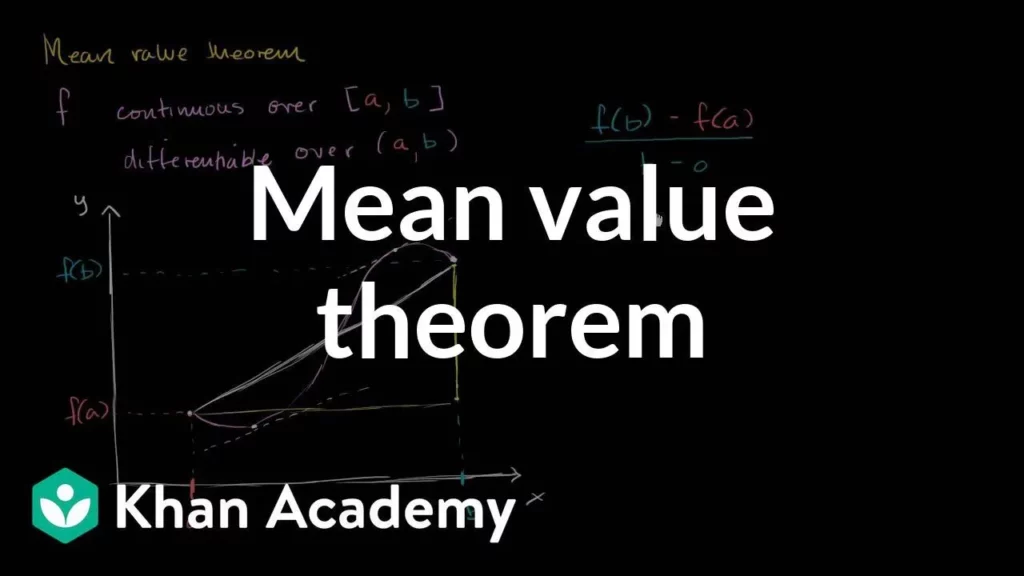
The Mean Value Theorem (MVT) is a fundamental concept in calculus that establishes a connection between the average rate of change of a function over a closed interval and the instantaneous rate of change at a specific point within that interval. For the MVT to apply, the function must be continuous on the closed interval \([a, b]\) and differentiable on the open interval \((a, b)\). The theorem assures that there exists at least one point \(c\) in \((a, b)\) where the slope of the tangent line (instantaneous rate of change) equals the slope of the secant line (average rate of change) between the endpoints \(a\) and \(b\).
Keynesian economics | Aggregate demand and aggregate supply | Macroeconomics
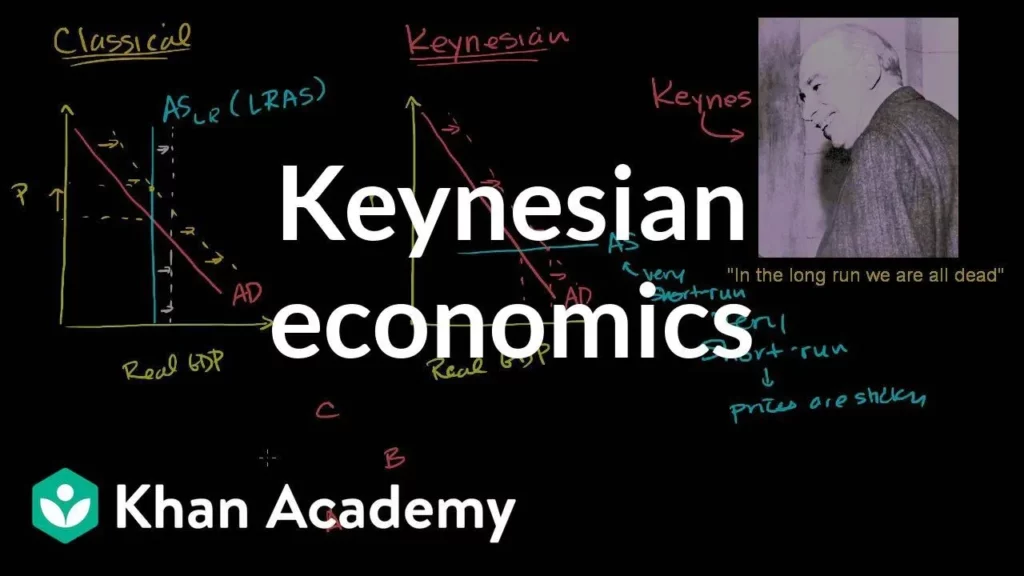
The lesson on Keynesian economics highlights John Maynard Keynes’s revolutionary ideas that emerged in response to the inadequacies of classical economic models during the Great Depression. Unlike classical economists, who believed that output is solely determined by productivity improvements and that price levels do not affect long-term output, Keynes emphasized the critical role of aggregate demand and the necessity of government intervention to stimulate economic activity during downturns. This approach advocates for a more integrated economic model that recognizes the importance of both demand-side and supply-side factors in achieving sustainable growth.