
How to Write an Imaginative Narrative for Kids Episode 7: Revising Your Story
In this lesson on revising an imaginative narrative for kids, the focus is on enhancing a fantasy story by making thoughtful changes. Writers are encouraged to reread their work from a reader’s perspective, asking questions about clarity and interest, and to incorporate more descriptive details while eliminating any confusing elements. The lesson emphasizes the importance of showing emotions through actions and concludes with a reminder to edit for mistakes to ensure a polished final draft.
How to Evaluate Sources for Relevance – Writing for Kids

In this lesson, students learn the importance of using relevant sources when working on projects or writing papers, as relevant sources provide essential and current information about a topic. The lesson distinguishes between primary sources, such as original documents and firsthand accounts, and secondary sources, which analyze or interpret primary information. Students are encouraged to ask specific questions and employ strategies to evaluate the relevance of their sources, ensuring their work is accurate and well-informed.
How to Evaluate Sources for Reliability – Writing for Kids

The lesson emphasizes the importance of using reliable sources when researching a topic to ensure accurate and trustworthy information. It provides key criteria for evaluating source reliability, including the author’s expertise, purpose, potential biases, cross-referencing with multiple sources, publication date, and awareness of commonly unreliable sources like advertisements and personal blogs. By applying these evaluation techniques, researchers can confidently share well-supported information.
How to Write for Your Audience – Writing Video For Kids
The lesson emphasizes the importance of understanding your audience before writing, as this knowledge influences the choice of style, tone, and language to make your writing engaging and relevant. By tailoring your writing to fit the audience’s background and interests, you can enhance the effectiveness of your communication, whether it’s formal for academic purposes or informal for peers. Ultimately, considering your audience leads to more meaningful and enjoyable writing experiences.
Story Elements For Kids: What Is a Character?
In this lesson, children learn about story elements, focusing specifically on characters, which are the people, animals, or creatures that can think, feel, and act within a story. Through examples and interactive questions, students distinguish between what qualifies as a character and what does not, reinforcing their understanding of this essential story element. The lesson encourages kids to think about the characters they encounter in their own reading experiences and invites them to continue exploring the world of stories.
Story Elements for Kids: What Is a Setting?
In this lesson, students learn about the concept of setting in stories, which refers to the time and place where events occur. By using descriptive adjectives, they can vividly illustrate settings, such as a warm day in a park or a spooky night at a haunted house. The lesson encourages students to think about and explore various settings in their favorite stories.
Parts of Speech for Kids: What is an Adjective?
This lesson introduces adjectives as a key part of speech that provides additional information about nouns, enhancing our understanding of people, places, and things. Through examples and activities, students learn how adjectives can describe appearance, feelings, actions, and quantities, making sentences more vivid and engaging. The lesson emphasizes the importance of adjectives in creating detailed and interesting descriptions in writing.
Parts of Speech for Kids: What is an Adverb?
In this lesson, students learn about adverbs, a type of word that enhances verbs, adjectives, or other adverbs by answering questions such as “How?”, “When?”, “Where?”, and “To what extent?”. The lesson explores various types of adverbs, including those that describe manner, time, place, and degree, and encourages students to incorporate adverbs into their writing to create more vivid and engaging sentences. By identifying adverbs in sentences and practicing their use, students can improve their understanding of this essential part of speech.
How to Create an Outline for Kids – Planning Your Writing
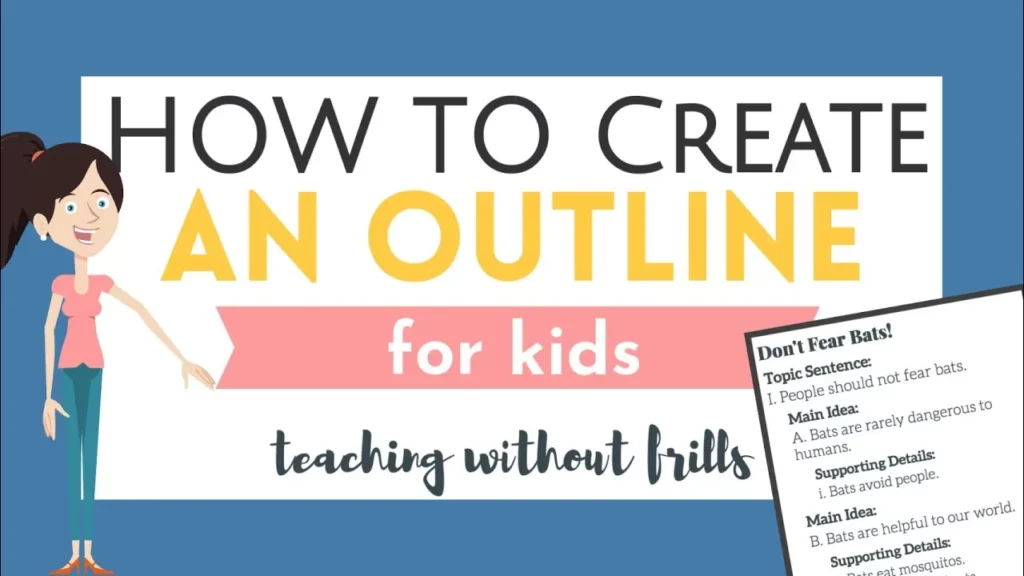
In this lesson, students learn the importance of creating an outline before writing a story or essay, as it serves as a roadmap to organize their thoughts and ensure clarity. The process involves understanding the writing task, developing a topic sentence, identifying main ideas with supporting details, and concluding with a summary statement. By following these steps, students can streamline their writing process and enhance their overall writing experience.
Fact or Opinion for Kids *UPDATED*
The lesson on “Fact and Opinion for Kids” explains the difference between facts, which are always true and can be proven, and opinions, which are personal beliefs that vary from person to person. It provides examples to illustrate these concepts and offers guidance on how to determine if a statement is a fact by asking if it is always true and can be proven.